
Fencing · South Jersey
NJ Pool Code Fence Requirements: Camden + Gloucester County
NJ pool-code fencing is not optional. Heights, picket spacing, gate hardware, and the township variations that catch homeowners off guard. Written by a Sicklerville contractor.
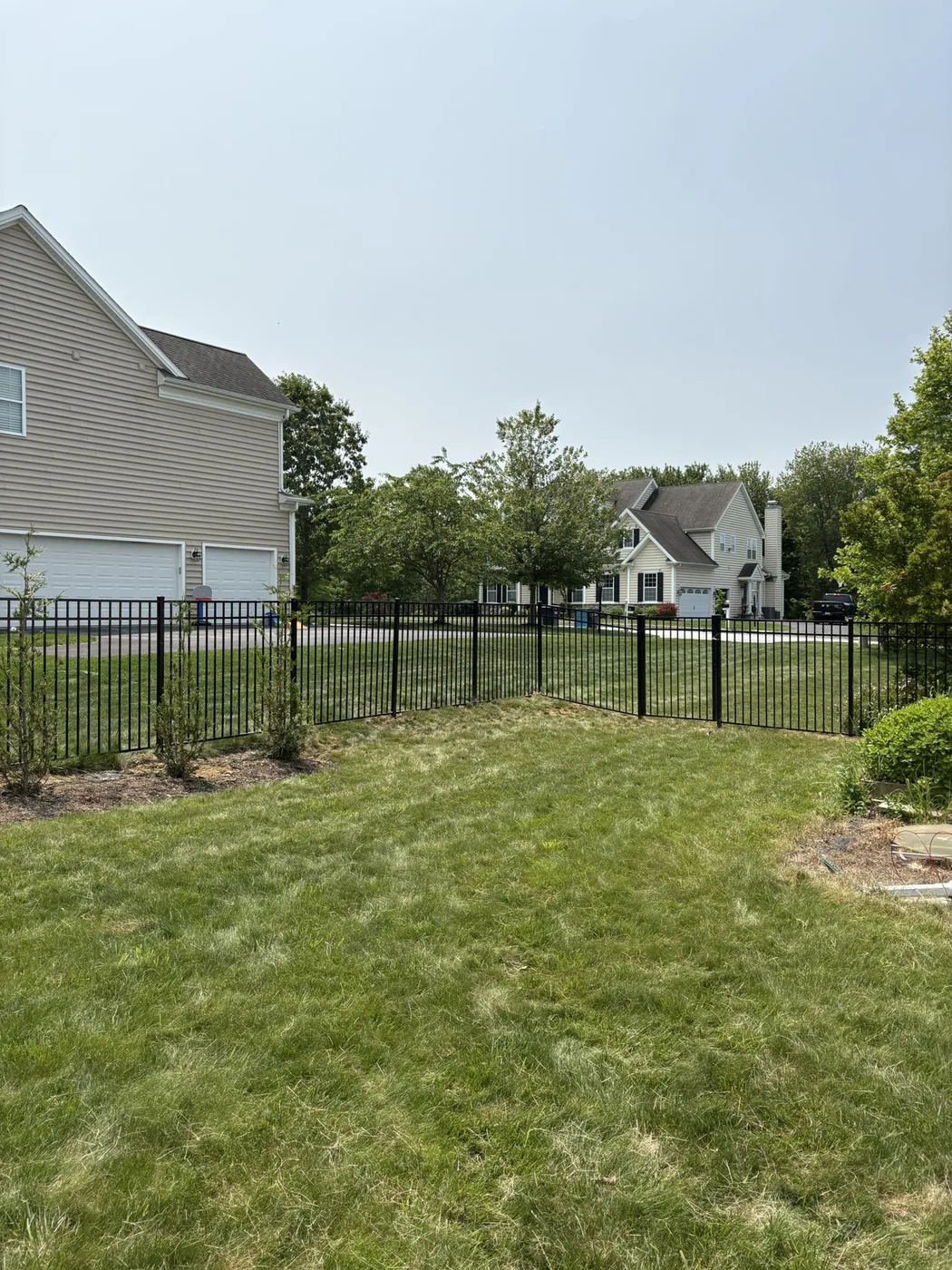
If you have an in-ground or above-ground pool with deck access in New Jersey, the pool barrier is not a recommendation. It is code. The rules are in the New Jersey Uniform Construction Code, which adopts the International Swimming Pool and Spa Code (ISPSC) with NJ amendments. Every Camden and Gloucester County township enforces them. We have installed enough pool-code fencing across Sicklerville, Turnersville, and Washington Township to know where homeowners get tripped up. Here is the field guide.
The basic requirements
Minimum height: 48 inches
Measured on the side facing away from the pool, from grade. If your yard slopes, this is measured at the lower side. Most townships will not pass a 47.5-inch fence and call it close enough. 48 inches is 48 inches.
No climbable surface within 48 inches
You cannot have a bench, AC unit, retaining wall, planter, or pool equipment pad within 48 inches of the outside of the fence at a height a kid could step up onto. This is the rule that homeowners most often miss. A 36-inch retaining wall right next to a 48-inch fence is a no-go because effectively the fence is only 12 inches from the top of the wall.
Picket spacing: maximum 4 inches
The gap between vertical pickets, or between the bottom of the fence and grade, cannot exceed 4 inches. The standard test is a 4-inch sphere. If it passes through, you fail inspection.
Decorative cutouts and openings
If the fence has decorative openings (scroll work, lattice, etc.), no opening can exceed 1.75 inches.
Horizontal members: at least 45 inches apart
If your fence has horizontal rails (most pickets do), the inside-face distance between the top and bottom rails has to be at least 45 inches. The thinking: closer rails make a ladder for a kid. If the horizontals are less than 45 inches apart, picket spacing has to drop to 1.75 inches.
Gate requirements (where most fences fail inspection)
Self-closing AND self-latching
Every gate that opens into the pool barrier has to close itself from any position and latch itself. A gate that closes but does not latch is a fail.
Latch height: at least 54 inches
If the latch is on the inside (pool side) of the gate, it has to be at least 54 inches above grade so a child cannot reach over and pop it.
Swing direction: away from the pool
Pool gates swing outward, away from the pool side. If a child pushes on it accidentally, they push themselves AWAY from the water, not toward it.
No openings in the gate itself
Same 4-inch sphere rule applies to the gate. Plus, within 18 inches of the latch on the inside, no opening can exceed half an inch.
Materials that work for pool code
In our experience across South Jersey:
- Aluminum: The default. Pre-engineered to meet picket spacing, comes with self-closing hinges and magnetic latches as a package. Powder-coated, 20+ year lifespan, looks clean. About $55 to $80 per linear foot installed.
- Vinyl (semi-private or picket profile): Works if the picket spacing and rail spacing meet code. Some vinyl privacy panels have decorative cutouts that fail inspection, so we spec carefully.
- Wood picket: Possible but harder to get right. The horizontal rails are usually on the outside (street side) of the pickets, which can be a climbable surface issue.
- Chain link: Technically allowed at 48 inches, but only with diamond mesh size of 1.25 inches or smaller. Most stock chain link is 2-inch mesh, which fails.
Township variations we have seen
- Winslow Township (Sicklerville): Standard ISPSC enforcement. Inspector will measure picket spacing on a random panel.
- Washington Township (Gloucester): Strict on the gate self-latching requirement. They want to see the latch engage from a 6-inch open position.
- Monroe Township (Williamstown): Requires a separate pool barrier permit on top of the fence permit.
- Gloucester Township (Blackwood): Has historically required a survey for any pool fence in a yard with a deck or hardscape.
What happens at inspection
Once the fence is up, the inspector walks the entire perimeter with a 4-inch sphere and a tape measure. They will:
- Slide the sphere along the bottom of the fence in 5 to 10 spots.
- Measure the latch height on every gate.
- Open every gate to confirm it self-closes and self-latches.
- Check there is no climbable surface within 48 inches.
If anything fails, you get a punch list and a re-inspection date. Re-inspection fees are usually $50 to $100 in our area.
What we do differently
We install pool-code fencing the way an inspector grades it. That means:
- We spec the material against the spacing rules BEFORE we order, not on install day.
- We set posts in concrete to NJ frost depth so the fence is still in spec 10 years from now.
- We hang gates last, after the rest of the fence is plumb and the latches sit flush.
- We meet the inspector on-site if the homeowner wants us there.
Get a pool-code fence quote
Have a pool installed or about to install one? Call us at (856) 361-8709 or send us the property details. We will measure, check the climbable-surface situation, and write a code-compliant quote on the spot.
Browse our fence installation services for everything we install, including aluminum pool-code panels.
Ready to talk through your project?