
Flooring · South Jersey
LVP vs. Hardwood for a South Jersey Basement
South Jersey basements get damp. Old hardwood does not survive that. Here is the honest breakdown of LVP vs. hardwood for a basement install in our service area.
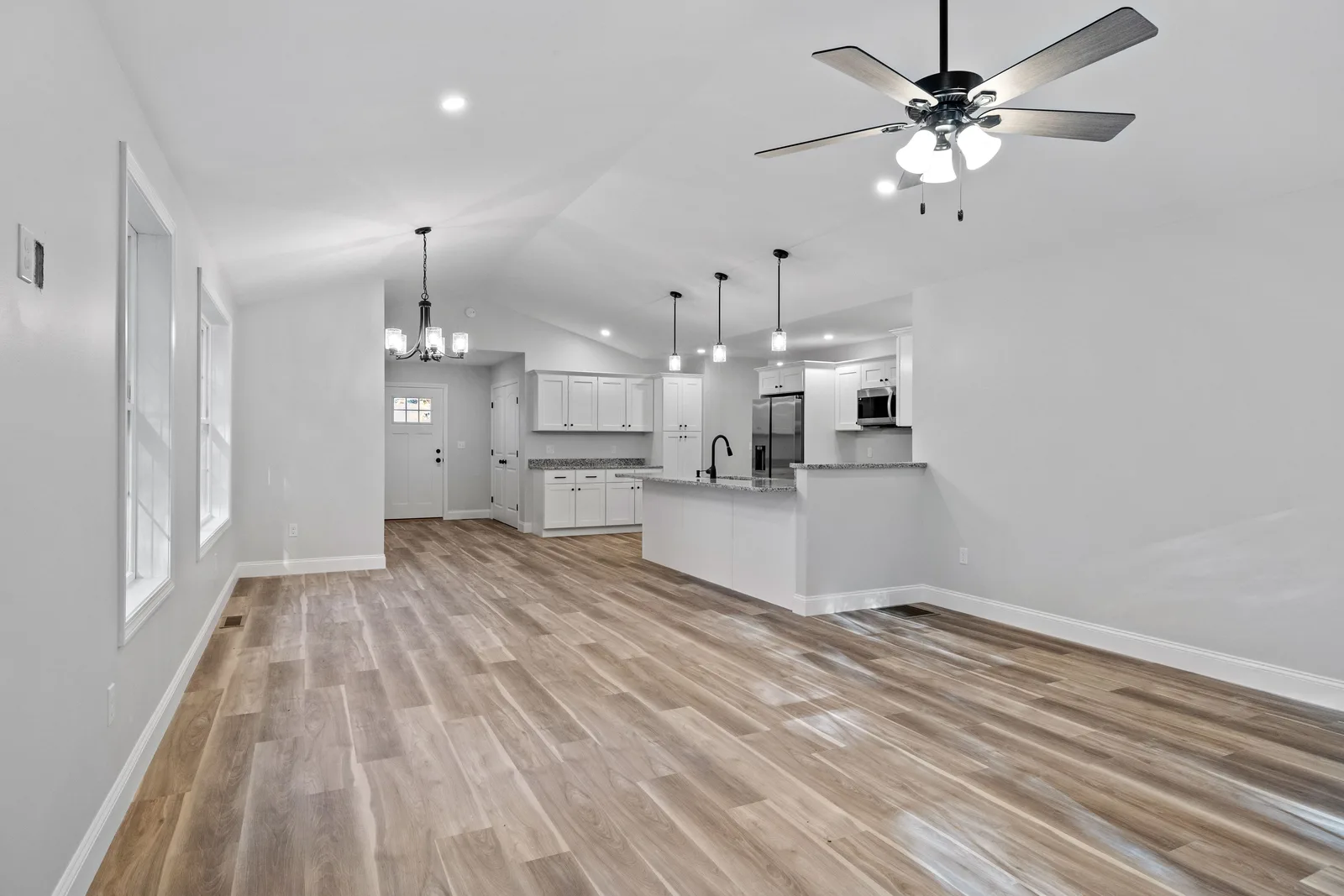
We get asked this question more than almost any other flooring question in South Jersey: should I put hardwood in my finished basement, or should I do luxury vinyl plank? Our honest answer, for almost every basement we have seen in Sicklerville, Williamstown, Blackwood, Turnersville, Washington Township, and Glassboro: do LVP. Here is why, and here is when it is OK to break that rule.
The short version
- South Jersey basements are humid. Many have a water history.
- Solid hardwood swells, cups, and crowns when humidity goes above 65 percent for any length of time.
- LVP is waterproof, dimensionally stable, and looks legitimately like wood.
- LVP costs $4 to $8 per square foot installed. Solid hardwood runs $9 to $14.
Why South Jersey basements are different
The water table in Gloucester and Camden County sits higher than in a lot of the country. Most basements in the area have at least one of these: a sump pump, perimeter drainage, a French drain, a dehumidifier running 9 months out of the year, or a history of taking water during a heavy rain.
Even basements that "never get water" usually sit at 55 to 70 percent relative humidity in the summer. Hardwood manufacturers spec their flooring for 35 to 55 percent. Run it above 65 percent for a season and the boards will cup. Run it through one wet event and the boards are done.
What LVP solves
Waterproof core
The plank is built around a rigid SPC (stone-plastic composite) or WPC (wood-plastic composite) core. Water on top, water from below, the core does not move. We have pulled up LVP from a basement that took 2 inches of standing water during a Nor'easter, dried it overnight, and re-laid the same planks.
Dimensional stability
LVP planks expand and contract maybe 1/32 of an inch across a full board with temperature swings. Hardwood can move 1/4 of an inch. That difference is the difference between tight seams forever and visible gaps in February.
Looks the part
LVP from 2018 looked plastic. LVP in 2026 has embossed grain, beveled edges that line up tile-style, plank widths up to 9 inches, and color matching that holds up at eye level. Most clients we install for cannot tell their installed LVP from real engineered hardwood from a standing position.
When hardwood IS the right call
We will not pretend hardwood never makes sense. Here is when it does:
- Above-grade installs only. Main floors, second floors, finished attic spaces. Not basements.
- You are doing a refinish, not a new install. If you already have hardwood, refinishing it is almost always cheaper than ripping it out for LVP. We do refinishing.
- The house is a high-end resale play. Some Camden and Gloucester County price tiers (think Mullica Hill, Mantua) still see a small resale bump from real hardwood on main floors. Not so much in basements.
What about engineered hardwood?
Engineered hardwood is real wood on top, plywood underneath. It handles humidity better than solid wood, but it is still wood. We have seen engineered hardwood cup in South Jersey basements at 70 percent humidity even with a dehumidifier running. If you are dead set on a wood-look basement floor, engineered is one notch better than solid. But LVP is two notches better than engineered.
The install process for basement LVP
The thing that kills basement floor installs is not the floor. It is the subfloor.
1. Moisture testing
Before we lay anything we run a calcium chloride test or use a Tramex meter on the concrete slab. If the slab is reading above 75 percent relative humidity, we put down a moisture barrier or recommend addressing the source (drainage, dehumidifier) first.
2. Subfloor levelling
Most basement slabs in our area are off-level by 1/4 to 3/4 of an inch across a single room. We grind high spots and float low spots with self-levelling compound before any plank goes down. Skip this step and the floor will click and pop forever.
3. Underlayment
Most click-lock LVP comes with an attached underlayment pad. Over concrete in a basement, we add a 6-mil poly vapor barrier under it. Belt and suspenders.
4. Install
Click-lock LVP installs as a floating floor. We leave a 1/4 inch expansion gap at every wall, run the planks perpendicular to the longest wall, and finish with shoe molding (which we paint to match the baseboard).
Costs we typically quote in South Jersey
- LVP, material plus install, 600 sq ft basement: $3,500 to $5,500.
- Self-leveller and moisture prep, if needed: $500 to $1,500.
- Removal of existing carpet or laminate: $300 to $800.
- Shoe molding paint and reinstall: $200 to $400.
Want LVP for your basement?
Call us at (856) 361-8709 or send us your square footage and the rooms. We measure, check the subfloor, and write a real quote on the spot. See the full lineup on our flooring services page.
Ready to talk through your project?